

Smart pool automation: off-the-shelf vs custom
What pool automation actually controls, when a brand-name system is the right call, and when it's worth having one built.
I've spent more than 20 years in the pool industry as a QBCC-licensed pool builder, and I've also built pool automation from scratch. So I get asked this a lot: should I just buy one of the big-brand automation systems, or is it worth having something built?
The honest answer is that most homeowners should buy off the shelf. But there are some situations where a custom system is clearly better, and they're more common than people think. This guide explains how to tell which one you're in.
What pool automation actually controls
"Pool automation" just means controlling your pool and spa equipment from one place, usually a wall controller and a phone app, instead of a row of separate switches and timers. Depending on the setup, it can control:
- Pumps: run times and, for variable-speed pumps, speeds
- Filtration schedules: how long and when the water is turned over
- Heating: gas heaters, heat pumps and solar, with set temperatures
- Lights: on, off, colours and light shows
- Chlorinators and sanitisers: output and run times
- Valves: switching between pool and spa, or solar on and off
- Spa jets, blowers and water features
- Extra outlets: garden lights, cleaners and other equipment
The value is convenience, lower running costs from smarter scheduling, and knowing your pool is doing what it should while you're away.
The off-the-shelf option
Most of the big pool equipment brands sell automation, and in Australia you'll commonly come across systems like AstralPool Connect 10, Pentair's automation range, Dontek Aquatek and Zodiac iAquaLink. Features and compatibility vary between models, so always check the current specifications with your pool shop or installer.
When off-the-shelf is the right choice
- Your equipment is mostly from one brand, and that brand's controller supports it
- It's your own home pool, used by your own household
- You want something proven, with a warranty and local service technicians who know it
- Your needs are standard: schedules, heating, lights and a phone app
For most family pools, that covers it. A brand-name system installed by a good pool tech is the sensible choice, and I'd tell you that even though I build custom systems.
When custom automation wins
Off-the-shelf systems are built for the average home pool. Custom starts to make sense when your situation isn't average:
Holiday rentals, retreats and accommodation
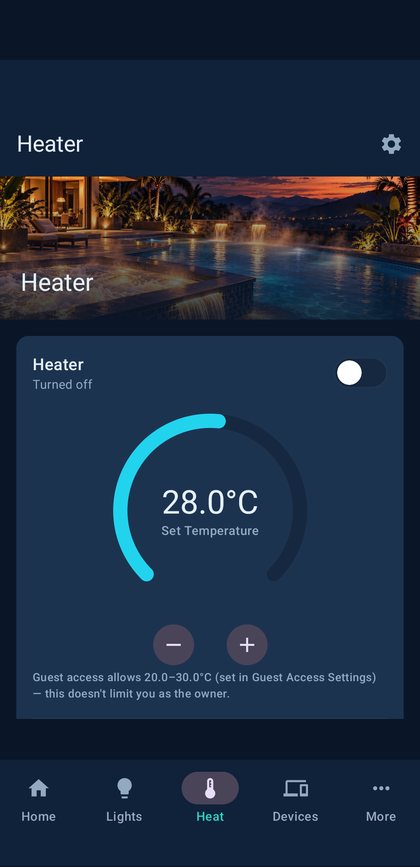
Guests need to use the pool and spa, but you don't want them turning the spa heater up to maximum and leaving it running for a week, or changing filtration settings. A custom system can give guests simple access, for example by scanning a QR code, with limits you set: maximum temperature, allowed hours, which equipment they can touch. On a pool and spa controller I built recently, guest temperature limits and QR access were core features from day one.
Managing many pools
If you're a pool service company, or an owner with several properties, the real cost is driving to sites to check things. A custom system can give one technician secure remote access to many controllers, with logs showing what happened and when.
Mixed or unusual equipment
Plenty of pools have a pump from one brand, a heater from another and lights from a third. Brand systems don't always play nicely with each other's gear. A custom controller can be designed around exactly what you've got.
Your own branded product
Pool builders and service companies sometimes want to offer automation under their own name. A white-label app can be rebranded with your logo and colours, so customers see your business every time they open it.
Something nobody sells
Running-cost estimates, links to other systems on the property, special safety interlocks: if the feature you need doesn't exist, building it is the only option.
Side-by-side comparison
| Off-the-shelf | Custom | |
|---|---|---|
| Best for | Home pools with standard needs | Rentals, retreats, multi-site, mixed gear, branded products |
| Equipment support | Best with the same brand | Designed around your equipment |
| Guest access and limits | Usually limited | Built to your rules |
| Remote management of many pools | Varies by brand | Built in from the start |
| Branding | The manufacturer's | Yours |
| Upfront cost | Lower for a single home pool | Higher, but spread across many sites or units |
| Service and warranty | Manufacturer and pool shops | From the builder, so agree it up front |
| Time to install | Days | Weeks for a first version |
Real examples
I've built custom pool automation in a few different forms over the years. One was a complete system for a retreat in the Scenic Rim, built around Pentair equipment with separate owner and guest control portals. Most recently, I built a full connected pool and spa controller with apps for Android, iPhone and the web, guest QR access, brand-matched light colours and a secure cloud link for technicians. You can read the full pool controller case study.
Safety first, whichever way you go
- Mains electrical work must be done by a licensed electrician. Pool equipment runs on 240V near water. Automation design should keep the low-voltage control side separate from the mains side.
- Automation doesn't replace pool safety. Fencing, gates and supervision rules still apply in full. Never rely on an app for child safety.
- Watch heat and moisture. Equipment areas get hot, wet and exposed to chlorine. Controllers and enclosures need to be designed and placed for those conditions.
- Keep manual control. A good system still lets you run the pool if the Wi-Fi or app is down.
Costs to think about
Comparing prices isn't as simple as the controller's sticker price. Whichever way you go, think about:
- Installation: electrician time, any new wiring, and fitting the controller in the equipment area
- Equipment compatibility: whether you'll need new pumps, valves or lights to work with a brand's system
- Running costs: good scheduling of pumps and heating can save money every month, which offsets the upfront cost
- Ongoing service: who supports the system, how updates happen, and what happens if a part fails
- Scale: for one pool, custom is rarely the cheapest. Across many sites or units, the cost per pool drops quickly.
A good test: if a brand-name system does everything you need without replacing working equipment, buy it. If you'd be paying to replace gear or working around missing features, get a quote for custom as well.
Quick decision guide
- One home pool, mostly one brand of equipment, standard needs: buy off the shelf
- Guests use the pool and you need limits: consider custom
- You manage several pools or properties: consider custom
- Mixed equipment that won't talk together: consider custom
- You want automation under your own brand: custom
Common questions
Is custom pool automation better than a brand-name system?
Not always. For a typical home pool, a brand-name system installed by a pool tech is usually the better choice. Custom makes sense for holiday rentals, multi-site management, mixed equipment or a branded product.
Can pool automation limit what holiday guests can do?
Yes, with the right system. A custom controller can give guests QR code access with limits the owner sets, such as a maximum spa temperature and which equipment they can use.
Do I need an electrician to install pool automation?
Yes for any mains (240V) wiring. In Australia that work must be done by a licensed electrician, even if the control side is low voltage.
Can one technician manage many pools remotely?
Yes. A system with a secure cloud link can let a technician connect to many controllers and check settings and logs without visiting each site.
Need pool automation that fits your situation?
With 20+ years in the pool industry and custom controllers already built, I can tell you honestly whether off-the-shelf or custom suits you. Custom builds start with a $2,200 Feasibility & Scoping Sprint that's credited to the build, and full product builds start from $16,500 including GST.
Ask me about your pool