

Case study: a smart pool and spa controller
How a complete connected controller went from idea to live testing in about two weeks, built by one person.
This project started with a simple request: a better way to run a pool and spa from a phone. It ended up as a complete connected product. That meant custom electronics, a 3D-designed enclosure, firmware, apps for Android, iPhone and the web, and a secure cloud link so a service technician can look after many controllers from one place.
The working system took about two weeks to build, and it's now in live testing. The client is private, so I won't name them, but I can walk through what was built, why it was built that way, and what I learned.
The challenge
Most pool owners end up with a mix of equipment: a pump from one brand, a heater from another, lights from a third, and a couple of outlets running a water feature or a cleaner. Each one has its own switch, timer or remote. Off-the-shelf automation can tie some of it together, but it's often expensive, locked to one brand's gear, and not built for situations like holiday rentals.
This client needed three things the usual options didn't do well together:
- Owner control of pumps, lights, heating and outlets from a phone, wherever they are
- Guest access that's safe to hand to holiday guests, without giving them the keys to everything
- Remote servicing, so a technician can check settings and logs without driving to the property
What I built
The hardware
The controller is built around an ESP32, a small, reliable microcontroller with Wi-Fi built in. I designed the control electronics to switch the pool equipment, and the enclosure was designed in CAD and 3D printed so it fits the equipment area properly. Any mains wiring at the equipment end is done by a licensed electrician.
The apps
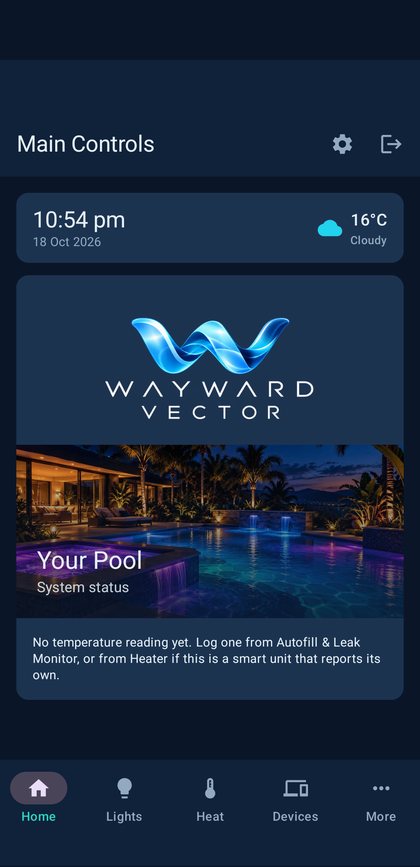
There are apps for Android, iPhone and the web, all talking to the same controller. The home screen shows the time, local weather and pool status at a glance, with one tap to reach each piece of equipment.
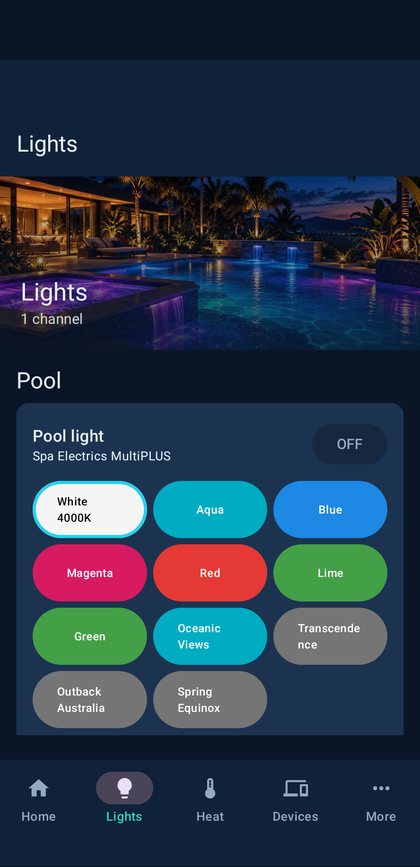
The lights screen controls a Spa Electrics pool light, including colours and light shows. I matched the on-screen colour buttons to the colours the light actually produces, so what you tap is what you see in the water.
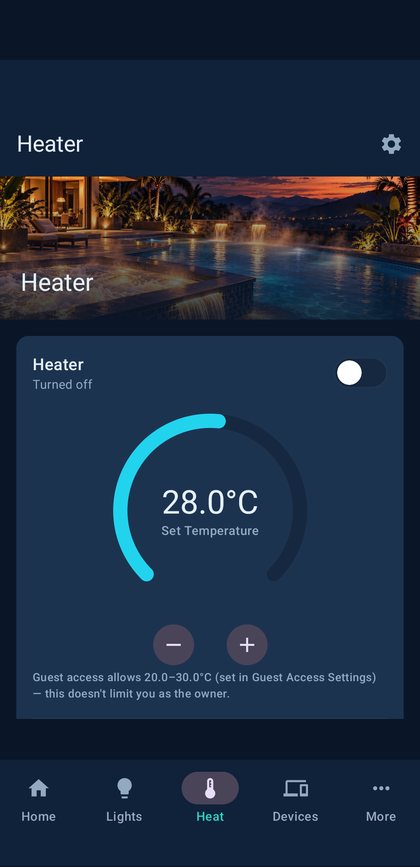
The heater screen uses a simple set-temperature dial. This is where the guest limits come in: the owner decides the highest temperature a guest can set, so nobody leaves the spa heater flat out at maximum all week. There's also a running-cost estimator, so owners can see roughly what their heating and pumping is costing.
Guest access by QR code
For holiday rentals, the owner can give guests access by QR code. Guests scan it and get a simplified set of controls, within limits the owner chooses. Nobody has to share a password or install anything complicated, and the owner stays in charge.
The technician cloud link
This was the part the client cared about most. A secure cloud database link means one service technician can connect to many controllers remotely, with access to the controls and logs. Instead of a site visit to find out why a pump isn't running on schedule, the technician can see what happened and often fix the setting from the office.
Built to be rebranded
The whole app can be rebranded for a different company in hours: logo, colours and name. That opens the door to pool companies offering it under their own brand instead of building their own from scratch.
How it came together in about two weeks
People are often surprised by the timeline. A few things made it possible:
- One builder for every layer. I did the electronics, enclosure, firmware, apps and cloud myself, so there were no handoffs or waiting for another agency to catch up.
- Proven parts first. Using a well-supported microcontroller and standard components meant the time went into the product, not into reinventing basics.
- Twenty-plus years in the pool industry. I already knew how pool equipment is wired, how owners actually use it, and what goes wrong on a pump pad. That knowledge cut out a lot of guesswork.
- A clear scope. We agreed what the first version had to do and kept extras for later.
What I learned
The back office matters as much as the app
The owner app is what people see, but the technician link is where the ongoing value is. Planning for many controllers and many users from day one was much easier than adding it later would have been.
Permissions are a design job
Working out who can do what (owner, guest, technician) took real thought. Getting it right is what makes the guest QR access safe to use.
Real-world testing finds what the bench doesn't
Wi-Fi range at the equipment area, heat inside the enclosure and the way guests actually use the app only show up on site. That's why the controller is in live testing now, before anything is called finished.
What it means for other businesses
The same building blocks show up in plenty of products outside pools. Anywhere there's equipment that needs switching, monitoring or limiting, and people who need different levels of access, this kind of system fits. Think pumps and tanks on rural properties, cool rooms and equipment in hospitality, or machinery that a service company maintains across many sites.
If you're considering something similar, the questions to settle first are the ones that shaped this build:
- What equipment does it need to control or read, and how is that equipment wired?
- Who uses it, and what should each type of user be allowed to do?
- Does anyone need to manage many units from one place?
- Will it be sold under one brand, or rebranded for others?
- What does the first version have to prove before more features are added?
Answering those up front is what kept this project to about two weeks. I've written a fuller guide on how to scope an IoT product if you want to work through them yourself.
Project summary
- Built: custom electronics, 3D-designed enclosure, firmware, Android, iPhone and web apps, cloud database
- Key features: pumps, lights, heating and outlets from a phone, guest QR access with owner limits, brand-matched light colours, running-cost estimator, technician remote access to controls and logs, rebrandable
- Timeline: about two weeks to a working system
- Status: in live testing
Common questions
How long did the pool controller take to build?
The working system took about two weeks, covering the electronics, enclosure, firmware, apps and cloud link. It's now in live testing before being called finished.
Can guests control the pool without full access?
Yes. Guests get access by QR code with a simplified set of controls, and the owner sets limits such as the highest spa temperature a guest can choose.
Can a technician manage more than one controller?
Yes. A secure cloud database link lets one service technician connect to many controllers remotely, with access to the controls and logs.
Can the app be sold under another company's brand?
Yes. The app was designed to be rebranded with a different name, logo and colours in hours, so a pool company could offer it as their own.
Got a product like this in mind?
I build connected products end to end: electronics, enclosure, apps and cloud. Full product builds start from $16,500 including GST, and most start with a $2,200 Feasibility & Scoping Sprint that's credited to the build.
Tell me about your product